
Waiting Room Heartbreak
Beneath the silence, the screens and the uncertainty of waiting rooms lies a truth about what it means to be human.

Each week, I share reflections for those who want to live deeper with gospel intentionality — stories about faith, grief, beauty and paying attention to what matters. If these essays resonate with you, consider becoming a paid subscriber for $5 a month. It means the world to me and makes this work possible.
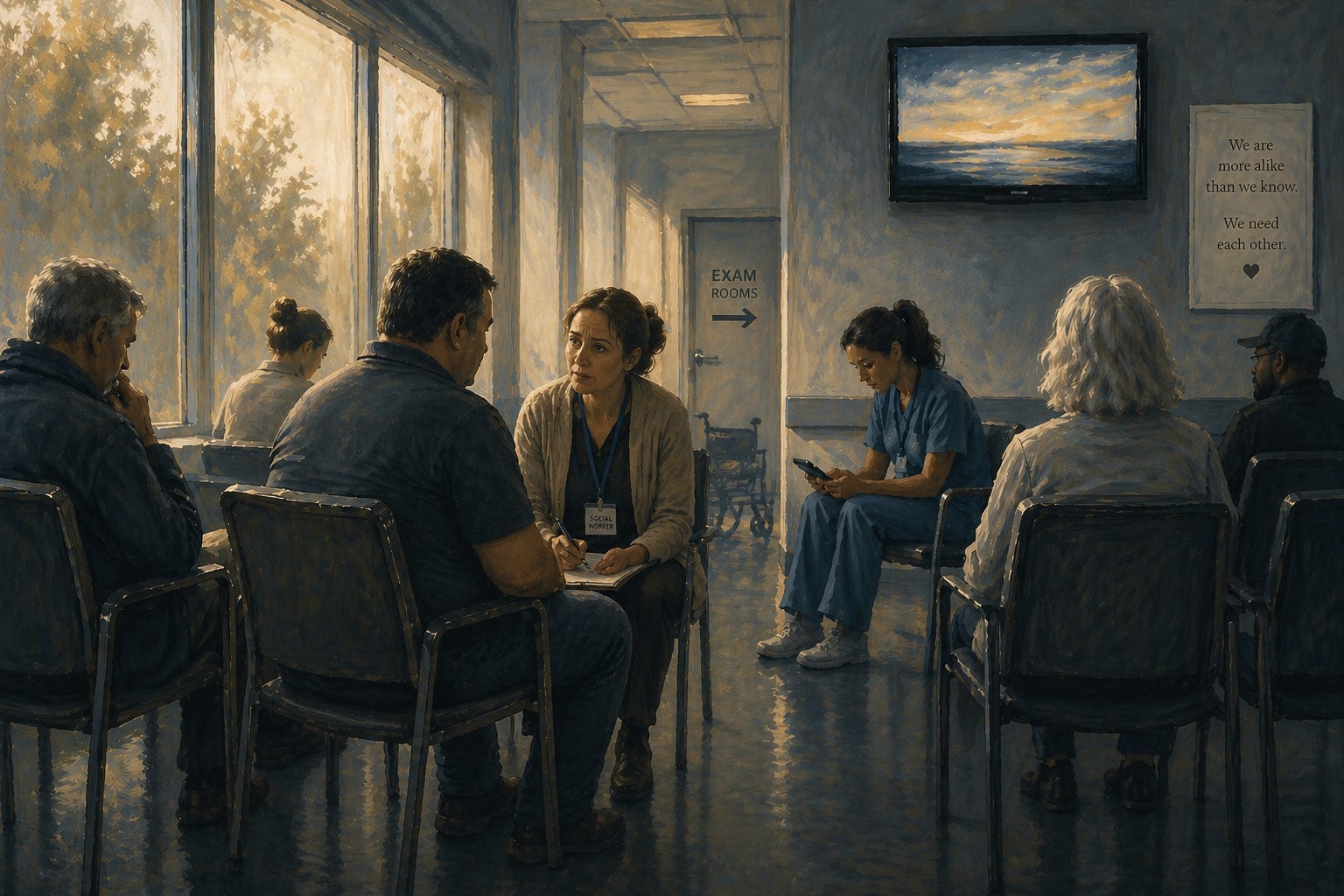
Medical waiting rooms are heartbreaking.
I sat in yet another one last week before a minor procedure. Like most people in those rooms, I was occupied with my own concerns – thinking about what was ahead, wondering how uncomfortable it might be, wanting it to be over with.
That seems to be the first instinct in a waiting room. We arrive carrying our own fears, our own discomfort and our own private questions. We watch the door. We listen for our names. We count the minutes.
But if we’re intentional, waiting rooms can turn our attention outward.
A man with physical challenges, probably a bit younger than me, spoke with a social worker nearby. I tried not to listen, but some conversations are impossible not to hear. Based on his answers, I got the sense that no one checks on him very often. He agreed to every suggestion the social worker made. I hope some of them helped ease his loneliness.
There was nothing dramatic about the exchange. No raised voices or tears. In fact, if I had to describe the man’s tone, I’d say it was optimistic. But deep down, I was saddened to hear how easily he had gone unseen.
In another waiting room I visited recently – this one for scans – a young woman in scrubs checked in and took a seat. She carried a heavy demeanor as she disappeared into her phone. It struck me that even people who spend their days caring for others eventually find themselves in the same chairs, waiting for their own names to be called.
Maybe that is what makes waiting rooms so tender and emotional for me. For a few minutes, titles, careers and appearances fade. The businessman, the retiree, the nurse, the caregiver, the patient – all of them are left with uncertainty.
What remains is need.
Not everyone in those rooms speaks. Most don’t. Many disappear into their phones, the televisions on the wall or their thoughts. But even in silence, something true is revealed: None of us is as self-sufficient as we imagine.
At some point, all of us learn this.
Waiting rooms quietly tell the truth. Bodies fail. Strength fades. Answers are delayed. We need skilled hands, kind words, good news and, sometimes, simply the courage to keep waiting. But most of all, we need each other.
If you enjoy these essays, you might also enjoy one of Lee’s books. When he isn’t writing essays, devotional books or Christian fiction, he is a freelance editor, as well as a freelance journalist who has written hundreds of articles for various newspapers and magazines. He’s also a fan of NASCAR, baseball, tennis, books, movies and coffee shops.
Books | Website | YouTube | Facebook | Instagram | X (Twitter) | Threads
Love this. I spent 6 hours in the waiting room this week too. I like to pray there, and I did for all the people including my daughter who was the patient. We gave encouragement to a very patient daddy who was trying his best to calm a cranky sick toddler. It was a long 6 hours but fruitful for the prayers were going up, rising like incense.
Waiting rooms are full of peace-giving opportunities and God's boomerang moments! Here's one unusual waiting room moment from my Be the Miracle stories -The Fear-Fighting Hug
Tears and trembling and wide-eyed fear characterized my youngest grandchildren’s faces on their first visit to Children’s Hospital to see their brother, David, who had cancer.
“Why are there so many cars in the parking lot, Gramma?”
Discovering most of those cars represented family and friends like them who were visiting a very ill child, oppressed them into silence. The views of children in various states of pre and post surgery being moved about the halls, and later, meeting the children and their families, gave us a thorough education in the recognition of pain and fear. It was also the perfect opportunity to teach the children how God’s love had already conquered that fear and every reason to feel fear. Feeling fear is the feeling of being out of God’s arms. Using that fear as a reminder to run to His embrace through prayer helped the children cope with their natural fears regarding their own future as well as that of others.
This time I was picking up David and his mom from the hospital x-ray area, and easily found the waiting room, following a silver-haired African-American man carrying twin toddlers. He sat down and held the girls, one on each knee. One girl appeared frail and listless, and the more robust twin was crying and would not allow her grandpa to comfort her.
I swear God pushed me toward her to give her a hug. I put out my arms like I would to my own child or grandchild. I’d like to pray for her, I requested. The man apologized that she never goes to strangers, hardly to other family members, then blinked in astonishment as she looked up, lifted her arms, and settled onto my chest, embracing me tightly.
Tenderly crooning to her, I sensed her need and prayed for her peace and healing as we paced back and forth across the waiting room. The little one had stopped crying and seemed to listen to the prayers winged to heaven on behalf of her and her family. I thought of Nehemiah 4:14 When he saw their fear, he told his people, “Do not be afraid…remember the Lord who is great and awesome.” And so I whispered to this little one that Jesus had sent a hug through me and she should not be afraid, for the Great and Awesome One was with her.
The man turned toward the elevator as a surprised grandmother exited, glancing between him and me and the now contented little one. Simultaneously, our grandson returned from his test and I moved to return the baby to her grandparents. A quick word of comfort regarding God’s care for them, and Nehemiah’s prayer that I’d shared with the little girl brightened their eyes.
A nurse arrived, remarking that the child’s contentment was unusual, and we turned toward the elevator. The little family waved goodbye, their thanks and blessings ringing in our ears as the elevator doors closed.
“What was that about, Gramma?” David asked, always sensitive to experiences of others. “Did you know those people?”
I shared the story of God directing me to comfort that little one, and each person’s response. “Good,” he whispered. “And you wouldn’t have been here to do that if I didn’t need these tests would you?”
I looked up into eyes that exposed an unselfish heart once again seeing beyond its’ own needs. This young man whose faith had taught me to trust my fears to the Lord, reached around my shoulders and pulled me into him for a side hug. “I didn’t realize,” I teased, so I wouldn’t cry, “that a fear-fighting-Jesus-hug had a boomerang in it.” His slow smile matched his quiet response, “Every time.”